

|
To Print: Click your browser's PRINT button.
NOTE: To view the article with Web enhancements, go to: http://www.medscape.com/viewarticle/541163 Case
Files From Stanford University Medical Center: Drug Resistance Testing
in Previously Untreated Patients With HIV -- Knowing What to Look for
and Choosing Appropriate Therapy Robert W. Shafer, MD; Dong Phuong Nguyen, PharmD; W. Jeffrey Fessel, MD Medscape General Medicine. 2006;8(3):32. ©2006 Medscape Posted 08/07/2006 Editor's NoteThis is the second in a series of case studies from the Division of Infectious Diseases at Stanford University Medical Center. This series examines optimization of antiretroviral therapy in a treatment-experienced patient with HIV, or in a treatment-naive patient with a particularly challenging initial presentation. Robert W. Shafer, MD, is the editor of this series. He is an Associate Professor in the Division of Infectious Diseases at Stanford University Medical Center and an expert on the management of HIV infection, with a particular focus on antiretroviral drug resistance mechanisms and testing. Case Patient and DiscussionCase PatientA 29-year-old bisexual man was hospitalized in 2003 with Pneumocystis jiroveci pneumonia. Serologic testing for HIV-1 was positive. The patient's CD4+ cell count was 35 cells/mcL and a plasma HIV-1 RNA level was > 500,000 copies/mL (VERSANT bDNA; Bayer Diagnostics). An HIV-1 genotype resistance assay revealed the reverse transcriptase (RT) mutations M41M/L and T215C. The patient completed a 3-week course of treatment for P jiroveci pneumonia and was started on stavudine (d4T)/lamivudine (3TC)/lopinavir (coformulated with low-dose ritonavir). Plasma HIV-1 RNA levels decreased over the ensuing weeks and within 4 months were < 75 copies/mL. The HIV RNA levels have remained < 75 copies/mL until the present time. CD4+ cells increased to > 300 cells/mcL during the first 6 months of therapy and eventually stabilized at about 500 cells/mcL (Figure 1). 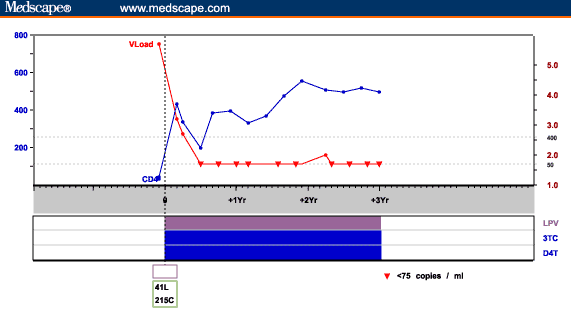 Figure 1. DiscussionThis case raises several timely HIV-1 treatment issues. First, the delay in HIV-1 diagnosis caused the patient to present with a life-threatening illness rather than at a presymptomatic stage of infection -- a topic discussed in the first report in this series.[1] Second, this patient had genotypic evidence of transmitted HIV-1 drug resistance. A discussion of this issue is timely because primary or transmitted drug resistance has been increasing over the past 5-10 years and drug resistance testing is now recommended for previously untreated persons as well as for persons failing a treatment regimen. Third, the patient had a marked increase in CD4+ cells with treatment. Not all patients have such a recovery and the factors contributing to immune reconstitution and CD4+ cell recovery are still being studied. Management of Persons With Primary Genotypic Resistance. This year, the US Department of Health and Human Services (DHHS) recommended that drug resistance testing be performed prior to the initiation of antiretroviral (ARV) therapy, ideally at the time of initial diagnosis.[2] The timing of this recommendation stems from the recent publication of 4 types of data. First, the frequency of transmitted or primary HIV-1 resistance has been increasing, and, in the United States and Europe, 5% to 15% of newly diagnosed persons and 10% to 25% of acutely infected individuals have genotypic evidence of drug resistance (reviewed in Pillay[3]). Second, transmitted drug resistance is clinically relevant. Retrospective studies have shown that persons infected with drug-resistant strains have an increased risk for virologic failure when treated with drugs to which their virus was resistant (for an example, see Figure 2[4]). Third, transmitted drug resistance often persists for 3 or more years, allaying concerns that transmitted resistant variants would be rapidly overgrown by wild-type variants and therefore no longer detectable if transmission had occurred more than several months earlier.[5] Fourth, genotypic resistance testing prior to choosing initial therapy is likely to be cost-effective.[6] 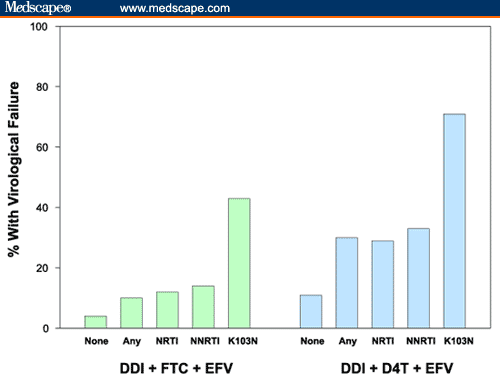 Figure 2. The DHHS has excellent guidelines for initial highly active antiretroviral therapy (HAART). However, these guidelines are designed for persons with wild-type viruses. As drug resistance testing is now increasingly performed in previously untreated patients, how should patients infected with drug-resistant viruses be treated? Although prospective randomized controlled studies have not been done to answer this question, data from several retrospective studies are available from which recommendations can be derived for 2 common scenarios: (1) transmission of viruses with nonnucleoside reverse transcriptase inhibitor (NNRTI)-resistance mutations and (2) transmission of viruses with thymidine analog mutations (TAMs) including mutations such as T215C also known as a "T215 revertant" (see Sidebar 1). Few clinicians would use an NNRTI-based initial ARV regimen in persons whose viruses contain 1 or more NNRTI resistance mutations. Indeed, a retrospective analysis of baseline samples from a Gilead Sciences trial (FTC-301A), which compared didanosine (ddI) + emtricitabine (FTC) + efavirenz (EFV) with ddI + d4T + EFV showed that the presence of an NNRTI resistance mutation, particularly K103N, prior to the start of therapy was significantly associated with virologic failure (resistance testing was done only after the study had been completed; Figure 2).[4] Whereas standard sequencing reliably detects only those minor variants that are present in about 30% of a patient's plasma virus population, several experimental real-time point mutation polymerase chain reaction (PCR) assays can detect variants present in as low as 1% of a patient's plasma virus population. At the XV International HIV Drug Resistance Workshop in Sitges, Spain, in June 2006, a group from the US Centers for Disease Control and Prevention described the results of a study in which a real-time PCR assay for M184V, K103N, and Y181C was applied to the baseline samples of 138 previously untreated persons enrolling in 2001 in a study of abacavir plus lamivudine (3TC) plus EFV, including 69 patients who had developed virologic failure with this regimen and 69 matched control patients who had maintained virologic suppression. Of 10 persons infected with a virus having at least 1 of the 3 mutations targeted (including 3 in whom mutations were detected only by real-time PCR), all developed virologic failures by month 6. The reason for the worse outcome associated with resistance in this study compared with FTC-301A is not known. Neither M41L alone, a T215 revertant alone, nor the combination of M41L and a T215 revertant reduces susceptibility to any of the nucleoside reverse transcriptase inhibitors (NRTIs). However, the presence of any of these mutations in a previously untreated individual strongly suggests that the individual was infected with a drug-resistant virus. In at least one study, the presence of T215 revertants has been associated with an increased risk for virologic failure during initial ARV therapy.[7] Moreover, even if the revertant (rather than one of the fully resistant variants) were transmitted, only a single mutation is required for the emergence of T215F or Y (rather than the 2 mutations required for viruses with the wild-type threonine at position 215[8]). Therefore, even though NNRTI resistance mutations were not detected in the virus sample from the patient described in this report, it seems prudent to have used a ritonavir-boosted protease inhibitor (lopinavir/r)-containing regimen rather than an NNRTI, because the success of an NNRTI-based regimen is more highly contingent on the presence of active NRTIs than is the success of lopinavir/r, which has a higher genetic barrier to resistance and which is usually highly effective for initial ARV therapy even in the absence of accompanying NRTIs.[9] Although the extremely high plasma HIV-1 RNA level may not interfere with the success of an efavirenz-based dual NRTI/NNRTI regimen for treating a wild-type virus,[10] such a high virus load may present an added risk in a patient whose virus population contains drug-resistant variants. Sidebar 2 summarizes several principles of treatment in patients with primary HIV-1 drug resistance. CD4+ Cell Recovery During Initial ARV Therapy. Large studies in the United States, United Kingdom, Switzerland, France, and Spain have characterized the CD4+ response to complete virologic suppression in patients beginning their first HAART regimen.[11-19] These studies show that there is a biphasic response to therapy with a more rapid increase in CD4+ cells during the first 3-4 months of therapy (approximately 20 cells/microliter [mcL] per month) followed by a slower increase in CD4+ cells (approximately 5 cells/mcL per month) during the subsequent months of therapy. However, about 10% to 15% of patients have CD4+ cell count increases < 100 cells/mcL. The factors most strongly associated with a poorer CD4+ increase are age > 40 years and incomplete virologic suppression. Higher levels of baseline HIV RNA levels appear to be associated with greater CD4+ cell recovery.[13,19] Although slightly greater increases in CD4+ cell count may occur in patients with lower baseline CD4+ cell counts, the increase is not enough to compensate for the lower starting point.[16,17] In addition to preventing acute illness and death caused by opportunistic infections, another rationale for diagnosing HIV-1 at an earlier stage of immunosuppression is that persons with complete plasma HIV-1 RNA suppression do not necessarily experience the marked immune reconstitution observed in the patient reported here. Therefore, the earlier a patient is diagnosed, the greater the probability that CD4+ cell count will either be above 200 cells/mcL or will increase above this level, thereby decreasing the risk for opportunistic infection and obviating the need for long-term prophylaxis for P jiroveci and other opportunistic infections. References
 Sidebar 1Codon 215 Revertants: Footprints of a Drug-resistant Virus
Sidebar 2Treatment of Patients With Primary HIV-1 Drug Resistance
Robert W. Shafer, MD, Division of Infectious Diseases, Department of Medicine, Stanford University, Stanford, California Dong Phuong Nguyen, PharmD, Kaiser Permanente Medical Care Program - Northern California, San Francisco, California W. Jeffrey Fessel, MD, Kaiser Permanente Medical Care Program - Northern California, San Francisco, California Disclosure:
Robert W. Shafer, MD, has disclosed that he has received grants for
clinical research from Abbott Laboratories, Bristol-Myers Squibb,
Celera Diagnostics, Gilead Sciences, GlaxoSmithKline, and
Hoffman-LaRoche; has served as an advisor or consultant for Bayer
Diagnostics, Bristol-Myers Squibb, and Celera Diagnostics; and has
received honoraria from Tibotec. Disclosure: Dong Phuong Nguyen, PharmD, has disclosed no relevant financial relationships. Disclosure: W. Jeffrey Fessel, MD, has disclosed no relevant financial relationships. |

